In our reading of Neer’s Chapter 3 this week, my interest was piqued by a small subsection on page 85 on interstate shrines. Since there was only a little bit of information on interstate shrines and their functions, for my blog post this week I wanted to explore the topic more in-depth.
Neer describes interstate shrines as those “independent of their home cities,” with a two-fold function of “provid[ing] venues for conspicuous consumption by aristocrats,” and “housing oracles as at Delphi.” (85) He paints a romanticized portrait of these geographically isolated shrines as elitist and athletic. Neer notes that the material record displays large amounts of private dedications, with little attention paid to architecture or architectural forms.
The most interesting concept I encountered in relation to these ancient shrines was their implicit function as neutral ground, providing arbitration areas and even mechanisms for public and private disputes. Oracles even served to legitimize courses of action when no consensus could be agreed upon: a yes-or-no question would be appealed to a god, and their response would form the concurrent course of action.
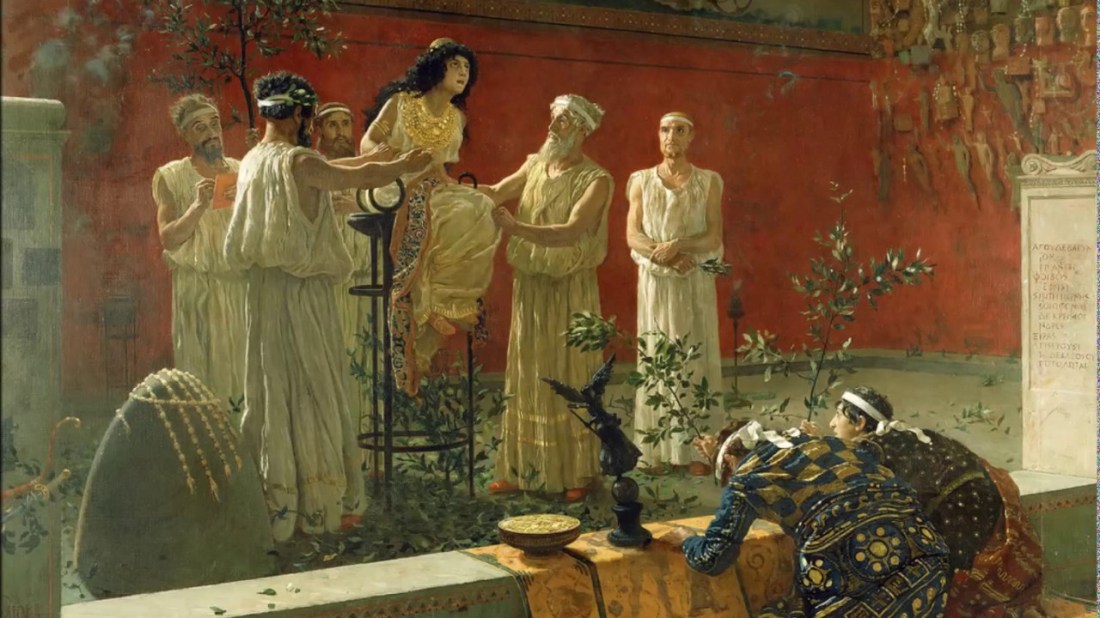
(An artist’s rendering of a priestess at Delphi. Note the luxurious displays in the image)
The Cambridge Companion to Archaic Greece offers some interesting insight into the defining contributions of interstate shrines towards elitism and elite ideologies in the ancient world. These sanctuaries were so appealing to the wealthy of old because of “the fact that they were not under control of any single city.” Instead, they were positioned exactly “in the interstices of the polis world.” (229) They provided an important platform for social displays of both physical and economic strength, and asserted bonds of camaraderie and solidarity among participants. These assertions in turn made the implied claim among the larger Greek communities that “wealth, or birth, or a special relationship with the gods was of greater significance than membership in a particular citizen community.” (229) I don’t think such displays of overt economic fortitude or physical demonstrations in games for rich young boys to play would have gone over so well in more normalized polis settings. I find the paradoxical social nature of these interstate shrines very interesting, and am considering doing my extended essay on the topic. I wonder if parallels could be drawn to certain hotels or restaurants in the modern world? While at first these shrines appear to be simply ritualistic, or escapes from everyday religious functions of the polis, their deeper and perhaps more dark civic capacities can be understood through more in-depth analysis and discussion much like this one.

 Ancient Greek Art and Archaeology
Hi Bryn!
I think your blog is really fascinating and I enjoyed your choice to touch on a subject that Neer did not explain in depth. If you are thinking about doing your extended essay on these sites and their political motivations, you may also want to consider why also geographically these locations were ideal. I was lucky to have visited Delphi several years ago, and my tour guide informed me about how the oracles were often hallucinating due to the toxic fumes they were inhaling from Delphi’s soil. I found this scientific article that could be of help to you in this subject: https://www.livescience.com/4277-theory-oracle-delphi-high.html
Best,
Chloe
LikeLike