
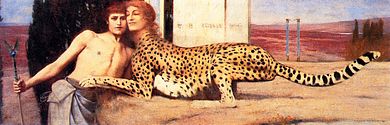
The sphinx as we know it today is a mythical creature with the body of a lion and a human head. Immortalized forever in the dramatic mythological tale of Oedipus, a malevolent sphinx guarded the entrance to the city of Thebes, posing a riddle to anyone who dared to enter, and killing them where they stood when they were unable to answer her riddle. The hero Oedipus was finally able to solve her riddle: “Which creature has one voice and yet becomes four-footed and two-footed and three-footed?” by answering, “Man—who crawls on all fours as a baby, then walks on two feet as an adult, and then uses a walking stick in old age.”
Yet the globalized iconographic symbol of the sphinx extends far beyond this Hellenistic legend and through far more millennia. I was surprised and impressed to learn that sphinx-like representations can be found across the world in vastly different and temporarily-removed ancient civilizations. On page 102 of Chapter 4, Neer explores the adaptation of Eastern sphinxes by the Greeks from earlier Syrian and Levantine models as they began to reappear in post-Bronze Age art at the start of the 7th century. He uses them as an example of how myth could be invented to explain strange or confusing images from such Eastern imports, and not the other way around as we usually understand passive imagery to be realized in the art historical and archaeological records.
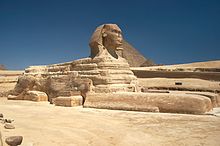
I want to explore the globalized nature of the sphinx icon as an example of iconographic parallels across seemingly unconnected and geographically-removed ancient societies. Beginning with the largest and most famous sphinx; the Great Sphinx of Giza,
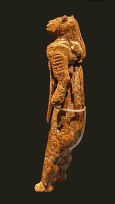
controversially dated to around 2500 BCE during the reign of the Pharaoh Khafre of the Old Kingdom period. It constitutes the oldest known monumental sculpture in Egypt and is a monumental manifestation of massive proportions, measuring 73 meters (240 ft) long from paw to tail, 20.21 m (66.31 ft) high from the base to the top of the head and 19 meters (62 ft) wide at its rear haunches. The oldest known sphinx however, was found near the Gobekli Tepe site in Turkey, just north of the Syrian border. It is dated to around 9500 BCE, predating the Egyptian and Greek finds by thousands of years. However, the oldest zoomorphic sculpture ever discovered, credited to be the oldest uncontested figurative art find in history also evokes sphinx-like motifs; carved out of mammoth ivory with the use of a flint stone knife. This lion-headed figurine was found in a stratigraphic layer of a cave in Germany that was carbon-dated to be between 35,000-40,000 years old, and dubbed the Löwenmensch figurine or Lion-man of the Hohlenstein-Stadel. In Southeast Asian art and mythology, this icon takes various diverse forms: manusiha or manuthiha (Pali, “man-lion”) in Myanmar, or as nara-simha (Sanskrit, “man-lion”) in Sri Lanka, purushamriga (Sanskrit, “man-beast”), purushamirugam (Tamil, “man-beast”), naravirala (Sanskrit, “man-cat”) in India, and norasingh (from Pali, “man-lion”, a variation of the Sanskrit “nara-simha”) or thep norasingh (“man-lion deity”), or nora nair in Thailand. Ancient Iranian societies had the Gopaitioshah, or Gopat, a winged lion with a human face, dated to around 2000 BCE and an important symbol of royal power.
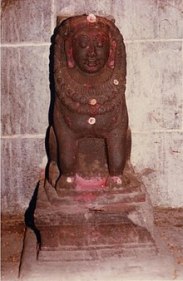
Across societies, young and old, these icons of royal power served similar purposes of guarding liminal areas such as temples, cities and sanctuaries. The fusion of powerful animalistic feline and human knowledge fused to create a formidable, super-human divine guard. Benevolent or malevolent, sphinxes and sphinx-like symbols are a timeless and globalized motif that can be traced to the very beginnings of humanity and human artistic representations.

 Ancient Greek Art and Archaeology
Hello Bryn,
I absolutely loved your blog entry! While I am familiar with the sphinx in Egypt, I wasn’t aware of its symbolism or widespread usage before this. Your post shows a lot of insightful thinking and you bring a lot of interesting points to light about the seemingly unconnected nature in which this image spread. Your conclusion left me with a lot to think about and I wonder about older, possibly uncovered variations of the sphinx.
-Isabella
LikeLike
Hi Bryn,
This is so interesting!
When I read Neer’s discussion of the sphinx — in which he talks about the appropriation of the figure from ancient Egypt — I began to wonder about the figure. More specifically, what about its form suggested to the Greeks that it was an arbiter of riddles? Your emphasis on its liminality seems to answer my question — if the sphinx exists between entities, always on a threshold, then its depiction as a mercurial force in the Greek world appears to be only natural; it is the riddler because it deals in the uncertainties of the riddle — in the doubleness of words, of symbols, of beings.
Thank for providing your insight.
– Vesta
LikeLike