In attempting to rationalize ancient descriptions of the Pythia’s ecstatic trance during which she would give her pronouncements, mainstream modern scholarship has largely
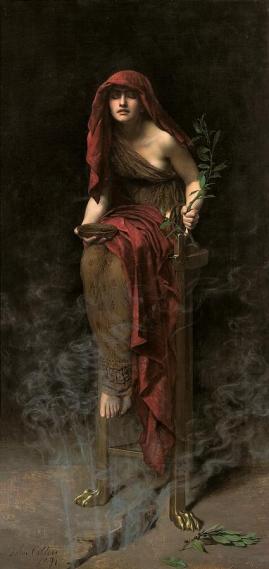
chalked this state up to “poetic inspiration,” with other scholars attributing it to ethylene fumes that could have wafted up from a fracture in the limestone, created by two hidden, intersecting faults directly under the temple. This idea of drug usage doesn’t suit Delphi’s idealized constructions of modern mainstream scholarship and effectively invalidates a rational understanding of the priestesses because of the general Western belief that drugs are irrational. Even the author of our textbook totally discounts the idea of psychotic usage in his section of Chapter 7 on Delphi, deeming it a “misconception,” that the “priestess was not a wild woman.” (184) It would seem that such assumptions stem from notions of cultural inferiority connected to drug usage. Yet these assumptions only function to limit or even totally prevent us from attaining a fuller understanding of such a society’s social norms and practices.
Following from this recognition of societally-imposed constraints in complete comprehension of the operations at Delphi, I decided to explore alternative theories as to what caused the strange state of the Pythia. I found one school of belief to be particularly convincing: the strange behavior of the Pythia was caused by the consumption of the oleander plant. Ancient sources describe the Pythia chewing “laurel” leaves and inhaling its smoke during the oracular process to inspire her divine mania. Both Lucan and Plutarch confirm this in their preserved writings.
The generic term “laurel” plant described in ancient sources is generally understood to reference the sweet bay plant, yet sweet bay produces none of the symptoms so famously recorded in the sources. However, another similar plant native to the Mediterranean region called oleander does fit this physical and toxicological description. Every single part of the oleander plant is poisonous: a lethal dose is somewhere between 5 and 15 leaves, after their poisonous glycosides have been fully absorbed by the body. Characteristic symptoms of contact include nausea, vomiting and abdominal pain; other symptoms may include hoarseness due to vocal edema, increased salivation, burning of the mouth, paresthesias of the tongue, and death. Neurological symptoms of oleander poisoning manifest themselves as states of increased excitement and agitation; other neurological symptoms include “tremor, drowsiness, ataxia, visual disturbances (yellow vision), mydriasis, weakness, and seizures.” (Harissis, 2014) These symptoms are acutely reminiscent of descriptions of the Pythia during her trance; her state was defined by her possession by Apollo, and was most basically understood to be epilepsy, which was considered during this time period to be the “sacred disease.” This state has also been recounted to include agitation, bounds, and leaps, “harshness” of voice, intense salivation, ataxia, loss of senses, and sometimes death (Lucain, De bello civili; Plutarch, Amatorius, De defectu oraculorum; Scholion, Aristophanem Plutum). Both the symptoms of oleander poisoning and the obfuscation of ancient categorizations of “laurel” create a convincing argument for the oleander theory as the cause of the unusual state of the Pythia at Delphi.
References:
Harissis, Haralampos V. “A Bittersweet Story: The True Nature of the Laurel of the Oracle of Delphi.” Perspectives in Biology and Medicine, vol. 57, no. 3, 2014, pp. 351–360., doi:10.1353/pbm.2014.0032.

 Ancient Greek Art and Archaeology
Dear Bryn,
Thanks for a great blog post. I really like the way you laid out the different aspects of Neer’s argument which helped echo a scholarly hegemony. Your point that there’s a notion of “cultural inferiority,” to drug use was very interesting. It makes me think of the criminalization of drugs in the U.S. and how that impacts the discussion of Delphi and the Pythia. You countered this modern projection by focusing on the facts in your discussion of the “laurel” plant in ancient sources. Great strategy!
Best,
Betts
LikeLike