Final Essay: Theorizing on the Lack of Environmental Representation in Ancient Greek Art

Modern scholarship largely attributes the general lack of representation of the natural world in Ancient Greek art to an ancient disregard for the natural world as well as an esteem for the civilized polis (city-state) setting above all else. The polis was the most basic and central unit of the political and social worlds of Ancient Greece. We think of cities today strictly as urban centers, but for the ancient Greeks, the concept of the polis was suggestive of an integrated whole: the urban center of the city as well as the extensive surrounding land. Such differing conceptions of the same general notion of a “city-state” gesture to, and leave much room for, modern misinterpretation of ancient actualities, especially as they are understood with relation to the natural environment.

This paper will explore the question: why is there a general lack of environmental representation in ancient Greek art? First, I will analyze ancient perspectives on the natural world in order to promote a more comprehensive understanding of how ancient Greeks perceived nature. Second, I will examine the representation of nature in the form of landscape elements in various artforms, with a focus on the artistic function of the employment of such elements. Finally, I will consider why there are so few representations of the natural world that survive in existence today, and draw attention to the inherently-limiting biases in modern interpretations of our already limited evidence. I will argue that the general lack of environmental representation in ancient Greek art is an issue of a lack of evidence, which is compounded by modern scholarship’s preconceived notions of nature in general, as well as what artistic representation of the natural world should look like.

Nature is a dominant theme in ancient thought, owing to the dramatic way it shaped civilization in very real and direct ways. In Hesiod’s epic Theogony, Hesoid presents himself as a shepherd whose inherently pastoral lifestyle is importantly in explicit contact with the natural world. This natural connection puts him in direct contact with the divine Muses whom he attributes the entire inspiration of his work to (Theog. 22). Thus the environment provides a direct avenue of communication to the otherwise inaccessible world of the divine. In a similar manner of thought, Plotinus characterized the natural world to be one of the important “launching points to the realm of mind” (Hornum, 1988). Plotinus focuses on universally appealing megaphenomena such as the sun, the stars, and life-sustaining waters as first-hand means of experiencing, and perhaps even transcending, alternative realms of being. These examples of ancient thought promote an aesthetic understanding of nature that seems to be “more about identification of aspects relevant or beneficial to oneself within it, and its potential to offer a culturally meaningful space to operate within” (Spencer, 22). We can extrapolate from these texts, a pattern in conceptualizing the natural world with respect to its function for humans. This notion of the environment having intrinsic function in regards to humanity can also be identified in the art historical record.

Minimal elements of landscapes, as opposed to landscapes in their entireties, are employed in ancient Greek art primarily with a limited function of representation. As Richard Neer points out, “Greek painting … always emphasized figures over their settings” (Neer, 221). Most basically, landscape elements functioned to locate a scene to be outdoors, in nature. Additionally, landscape elements could also serve as attributes of the gods and goddesses, make reference to a specific myth or hero, or symbolize abstract concepts that are not easily depicted, such as war, immortality, or victory. Natural settings were minimally expressed in accordance with “the Archaic and Classical impulse to inscribe the natural world,” which manifested itself in this minimalistic style by “carefully limiting human interaction with wild Nature” (Giesecke, 2007).

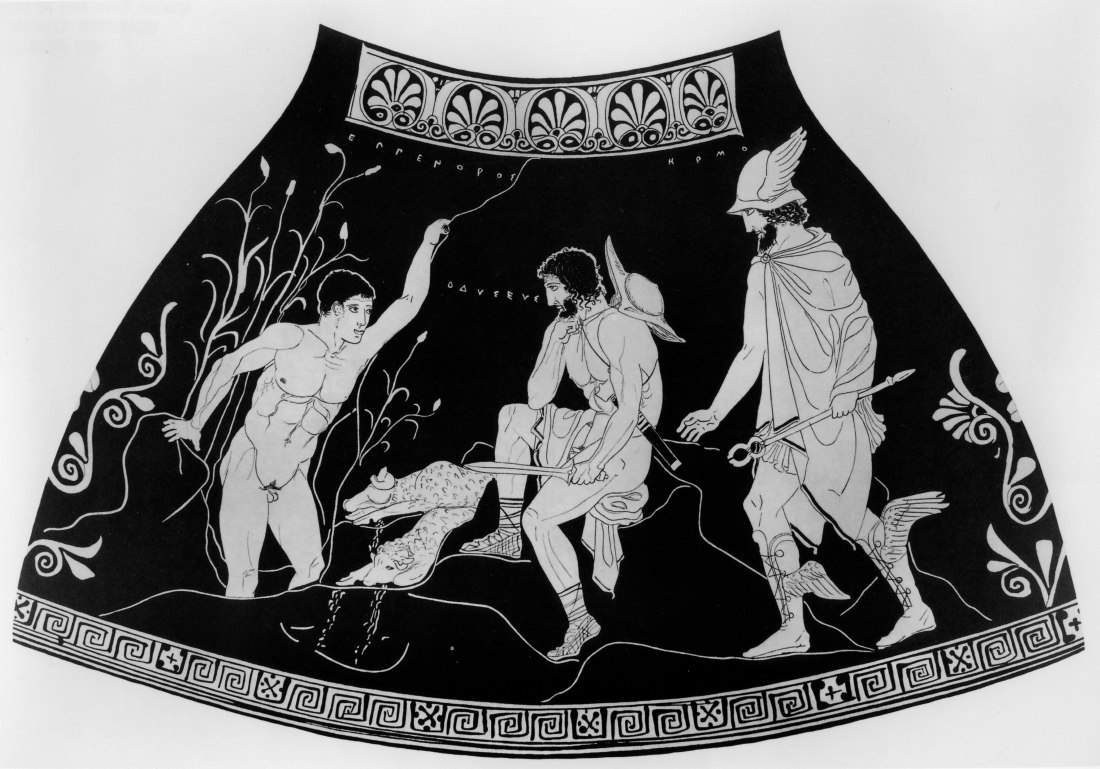
Depictions of the natural environment in Greek vase painting are highly uncommon, with specifically identifiable scenes being even more uncommon. The Attic red figure vase-style of the High Classical period is reflective of the ancient Greek impulse for inscribing nature, with the natural world carefully restrained in representation, framing depictions of human figures on vase scenes instead of overpowering them. The Lykaon Painter’s pelikē, a decorated storage jar ca. 440 BCE is an excellent example of the evolution of Greek environmental “landscape” painting (Figure 1). It shows Homer’s story of Odysseus’ journey to the Underworld and was described by the Boston Museum of Fine Arts Classical Antiquities Curator Lacey Caskey as being “of unusual, even startling interest” (Caskey, 1934). Thin, undulating lines of paint, spatially staggered on different levels characterize a rocky terrain. The scene is framed by tall, wispy reeds which function to indicate the scene’s proximity to a river. These two minimal natural features stage a specific wet and rocky environment that, in combination with the labeled figures, (Odysseus, Hermes, and the ghost of Elpenor) leave no doubt as to the location of the scene at the confluence of the Underworld’s rivers as described in Homer’s Odyssey.
2525

Figure 1. Red-figure pelikē: drawing of Side A, Odysseus, Elpenor, and Hermes in the Underworld. The Lykaon Painter, c. 440 BCE. The Museum of Fine Arts, Boston, William Amory Gardner Fund, inv. no. 34.79.

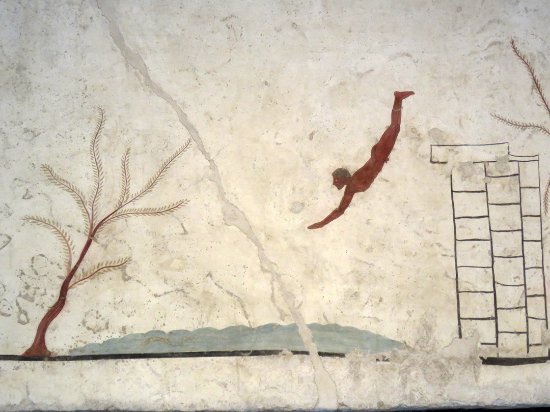
Another significant example of this minimalistic style of environmental representation is a fresco from the Tomba del Tuffatore, or Tomb of the Diver, dated to around 470 BCE (Figure 2). The necropolis the tomb is situated within is just 1.5 km south of the Greek city of Paestum in Magna Graecia. The painted ceiling, from which the tomb draws its name, shows a boy diving from a platform. The diver is “just a small element in a larger landscape,” (Neer, 221) framed by trees on either side. While the diver is the central focal point of the fresco that immediately attracts the viewer’s eye, it is interesting that the largest and most detailed images of the scene are the trees, with each leaf individually and painstakingly painted by the artist. For the ancient viewer, the scene might have been reminiscent of the nearby River Sele, functioning to evoke a more regional and thus personal connection to the fresco.
il-tuffatore

Figure 2. Fresco from the Tomb of the Diver. Paestum, c.470-469 BCE. National Museum of Paestum, Capaccio, Italy.

Turning now to the general lack of surviving archaeological evidence of environmental representation, I will begin by theorizing why this may be. In considering the artistic tendency to represent the natural world using paint as a medium, I am inclined to conceptualize the lack of evidence in connection to this preferred medium. Painting was the easiest way to show natural scenes; sculpture would have been much more difficult to render environmental imagery on, and probably more affective was the mere lack of demand for it, owing to a preference for human iconography. In comparison to other artforms of ancient Greece in existence today, a disproportionately less amount of paintings survive. It is crucial, first and foremost, that an absence of evidence should never be interpreted as evidence of absence. Fewer surviving paintings do not mean that painting was rare. Most surviving intact examples of painting are preserved in tombs, “but Greek tombs were usually simple; any extra resources tended to go toward a fancy marker” (Neer, 220). Paintings are in fact, much less likely to survive because they were usually painted on wood, which has since rotted away, or on walls of private or public buildings which have collapsed or been rebuilt.

Modern scholarship’s general failure to consider how our own perceptions of what environmental art looks like may serve to distort our understanding. A lack of representation of the natural world, as we expect it should be represented, has (not very thoughtfully) been interpreted as a total lack of representation. I recognize my own bias following from a similar line of thought; when I imagine environmental representation in art, I think of paintings that almost exclusively depict extremely detailed scenes of nature. Modern attitudes in general do not take very seriously the important and defining role that the environment plays in the maintenance and continuation of the very existence of humanity. We see this exemplified in the majority of society’s slow, or even failure to, uptake the reality of climate change and global warming, even when confronted with massive amounts of data and evidence documenting this climate crisis. Both ancient and modern thought share a similar theme of an inherent lack of agency in human interactions with the environment, as well as a perspective that the environment is something that needs to be conquered. Its worth considering the false implicit logic of these lines of thinking that may lead one to infer that because we do not respect the environment, the ancient Greeks surely didn’t either. We perceive an ancient bias, and accept it because it easily aligns with modern bias.

It seems to me then, that such modern biases inhibit the way in which we perceive ancient Greek representations of nature. The few representations of the natural world that survive, in combination with interpretive biases greatly limit our comprehension.The minimalist approach of the Greeks does not fit our conceptions of environmental art, thus we do not consider it as such. I would argue that ignoring any environmental aspect of a society is a failure to attempt to foster any deeper understanding of the society in question. How can we hope to understand a society if we do not also understand the many ways in which they interacted with the environment? This interpretation is especially problematic when it leads to related environmental factors being largely ignored in early studies and scholarship of the Greeks, as well as other past societies. Modern eyes do not understand the Greeks or their art as in connection with nature; this is a failure not of the Greeks to understand the natural world they inhabited, but on our behalf to properly rid ourselves of our own preconceived notions of what nature and natural representation should look like.


Bibliography:

  • Caskey, L. D. 1934. “Odysseus and Elpenor in the Lower World.” Bulletin of the Museum of Fine Arts XXXII.191:40–44.
  • Hesiod. Theogony; And, Works and Days. Ann Arbor: University of Michigan Press, 2006.
  • Hornum, M. 1988. (ed.) Porphyry’s Launching-Points to the Realm of Mind. Grand Rapids: Phanes Press.
  • Neer, Richard T. Greek Art and Archaeology: A New History, c. 2500-c. 150 BCE. Thames & Hudson, 2012.
  • Spencer, Diana. “Aesthetic, Sociological, and Exploitative Attitudes to Landscape in Greco-Roman Literature, Art, and Culture.” Oxford Handbooks Online. January 10, 2017. Oxford University Press.

Closing Conclusions

For my final blog post, I wanted to explore a continuation of my reflections from class on how I understand art, and how my understanding has changed over the course of the semester. My understanding of ancient art especially has changed the most. Reading R. R. R. Smith’s essay, The use of images: visual history and ancient history, at the beginning of the semester and then again at the end of the semester was helpful in evaluating my own conceptions of the notion of “ancient art.” I was most surprised at how differently I understood Smith’s argument at the end of the semester compared to the start. I think Smith summed it up most succinctly when he argued that “ ‘Ancient art’ is a convenient collective misnomer for all these figured artefacts, but we should be aware that this is a very different, bigger and shaggier, beast from art in our own time.” (Smith, 64; emphasis added) I really like this imagery of ancient art as a “shaggier beast,” though I do think Smith should be careful in his conceptual othering of ancient cultures as he constructs their art as “beasts.” The point I believe he is trying to make is not that ancient art is uncivilized or less human, only that ancient notions of art are fundamentally distinct from modern notions, and we should be careful not to portray them according to modern conceptions. He condones “try[ing] to separate out ancient images from the wider visual and material history of antiquity” (Smith, 67), an argument that I have a newfound appreciation for after our semester of studies. In modern times, designating something as art privileges it’s aesthetic over every other aspect of it. Arguably, this designation can mislead the observer into a false way of looking at the object in question. To me, this is one of the biggest challenges modern art historians face in their attempts to study ancient art or material. How can we reconcile modern appreciation of an ancient object for its most fundamental aspect of aesthetic while accurately representing its history and function?

At the beginning of the semester, I wrote in my notes that “art” was an aesthetic manifestation of society’s desires and perspectives on decor. I think that my original understanding was inherently limited to what I perceived to be art, or what other people told me was art. I had never really questioned the societal impositions that clouded my understanding of the subject. As Professor Valentine pushed us over the course of the semester to challenge these modern [potentially mis]conceptions, I slowly came to the realization that art is much more complicated than a simple labeling of an object as such. What is the point of accepting an object’s label of “art” with no context or awareness? Reducing an object to a basic, singular visual representation fails to respect the multi-faceted dimensions of its very existence. The study of art history is not just memorizing objects and their context, but engaging on a deeper level with the object as a way to understand past peoples and their practices, to situate your understanding within the proper socio- and art-historical sphere of knowledge. Essentially, I learned that there is a fundamental and crucial difference in accepting something to be art because you are told it is art by a museum or a textbook, and understanding something as art. My definition and more personal understanding of the term has developed to include an emphasis on aesthetic above all else. This does not imply merely a visually-pleasing aesthetic; it’s emphasis on visuals is one of visual functionality, performing a function — be it religious, personal, private, political, etc. Additionally, I am significantly more aware of my own application of the term, the importance of context, and following from this, the consequent misconceptions that may accompany the usage of the term in practical application.


References:

Smith, R. R. (2006). The use of images: Visual history and ancient history. In T. P. Wiseman (Author), Classics in progress: Essays on ancient Greece and Rome (pp. 59-102). Oxford: British Academy by Oxford University Press.

Gender and the Getty: The Case of Marion True

I was disappointed with myself this week in class when I realized that it had never occurred to me that gender may have played a defining role in the legal consequences of the Getty’s Aphrodite scandal. In reading Jason Felch and Ralph Frammolino’s Chasing Aphrodite: the Hunt for Looted Antiquities at the World’s Richest Museum, I had merely accepted their sensationalized portrayal of Marion True as fact. In reading their account of the Getty’s acquisition practices, I realize that it is crucial to keep in mind that sensationalization is what sells. I found this very telling description of the people involved with the Getty from the online summary page of the blog that Felch and Frammolino maintain for their project: “The outlandish characters and bad behavior could come straight from the pages of a thriller—the wealthy recluse founder, the cagey Italian art investigator, the playboy curator, the narcissist CEO.” Forcing real people into character roles from a “thriller” seems to be more of a ploy to generate publicity and spark public interest, and only functions to convolute the reality of the events in question. Just look at the paradoxical and misleading description here of Marion True as the “playboy curator.” Describing one of the first high-profile female curators as a “playboy” is inherently misrepresentative of one of the most basic aspects of her identity and only serves to completely dismiss any notions in the reader’s mind of the role that gender may have played in this case.

Engaging only in Felch and Frammolino’s account was not enough. I wanted to hear Marion True’s side as well, in order to get a better sense of what had really happened and why she in particular was singled out in such a public manner for a global audience. In 2007, Paolo Giorgio Ferri, the state prosecutor in True’s case told The New Yorker, “It will not be an acquittal. There’s no reason to go on in the outrage against Marion True. The more the trial goes on, the more outrage. It’s better to reach a judgment.” A 2010 interview with The New Yorker was particularly enlightening in considering aspects of the case not explored adequately by Felch and Frammolino:


Has the Getty made any effort to reconcile with you?

No. And I have nothing but the greatest contempt for them in the world. They acted like I ran the place. Above me I had a chief curator who was deputy director, a director, an in-house counsel, a president, a board of trustees to whom the president reported, and a chairman of the board. What about the lawyers who drafted the acquisition policy, who were supposed to be vetting all documents? They were perfectly happy to assure all that [the alleged acquisition of illegal art] was my work. Never once have [former Getty director] John Walsh or [his successor] Deborah Gribbon stepped forward to say one word about their responsibility.


Regardless of the morality or legality of True and the rest of the Getty’s actions, it is important in our more recent conceptualization of them that we remember the danger of a single story. Not only is it dangerous in holding those involved appropriately accountable, but also in representing the past. We should strive to represent the past as truthfully as possible while we still have agency over the narrative so we do not allow the same mistakes of history to repeat themselves.


References:

Eakin, H. (2010, October 14). Marion True on her Trial and Ordeal. The New Yorker. Retrieved November 30, 2018, from https://www.newyorker.com/news/news-desk/marion-true-on-her-trial-and-ordeal

The Parthenon’s Problematic Politics

Would not theft by another name still be theft? Just because there is no ruling political body of the art would to decree the British Museum’s actions as immoral and illegal does not mean that their actions are permissible. The looting of the Elgin marbles was undeniably an act of thievery, thus they should be returned to their original country of origin. Elgin claimed that the government of the Ottoman Empire gave him permission to do so, yet it seems paradoxical to continue to give any credibility to the questionable testimonies of fallen empires. More importantly, why should permission from the Ottoman government make Elgin’s actions permissible? The Elgin marbles belonged to neither of these entities; in truth they belong to the citizens of Greece or, more specifically, the citizens of Athens.

The paradoxes of the British government’s argument don’t just stop here. They have claimed that returning the marbles would “set a precedent” for returning other looted antiquities, leaving the British Museum empty. Furthermore, less people would see the marbles in Greece versus the British Museum, and fewer academics would have access to them. Another argument has been made that returning the marbles wouldn’t fully re-unite the Parthenon marbles since there are still pieces in other parts of the world, and they could never be remounted on the actual facade of the Parthenon again, so why even bother? When this logic is reframed outside of the art historial world, the major fallacies of the British government’s argument become much more apparent. Thus the case for reunification of the Parthenon marbles is not about rights of ownership, current or historic, but cultural and ethical. This is a case of morality. The responsibility of justification should be on those who resist restoring the integrity of the sculptures from the Parthenon. Restoring integrity in this manner allows future visitors to the Parthenon museum to fully appreciate the friezes in their proper context of the Acropolis mount, simultaneously promoting appreciation for the artistic and historical significance of the artifacts themselves, reunited one one sacred hill as their original artists intended.

Tomba del Tuffatore

I was quite struck by the Tomb of the Diver cover slab fresco from one of our recent readings, so for my blog post this week I wanted to investigate the work in a more independent context in order to explore its importance more in-depth. What I found most striking about the fresco at first glance was the eternality of its theme and consequent mode of expression. Here I was, looking at the fresco nearly 2,500 years later, and still able to immediately identify exactly what the artist was depicting. Not only that, but diving as a motif is still very applicable to my daily life as a member of the swim/dive team. Even the swan dive technique remains the same, although the diver’s toes should be more pointed than flexed.

Turning now to the history and importance of this archaeological site; the Tomb of the Diver (Tomba del Tuffatore) was built around 470 BCE in southern Italy. The necropolis the tomb is situated within is just 1.5 km south of the Greek city of Paestum in Magna Graecia. This geographical context is an important part of conceptualizing the tomb as an artifact of converging cultures: Greek and Etruscan. Paestum would have been a liminal sort of city, right on the border of Greek and Etruscan zones of influence at the nearby River Sele. Greek wall paintings in other types of buildings were common but most have not survived, while Etruscan/other regional Italic societies have left behind many well-preserved tomb paintings.  Obviously, cross-cultural contact with their Etsrucan neighbors inspired the Greeks to adopt the Etruscan practices of tomb paintings and human depictions, with this unique artifact reflecting this immersion of cultures as manifested in funerary art. Shockingly underscored by Neer, this tomb is actually the “only example of Greek painting with figured scenes dating from the Orientalizing, Archaic, or Classical periods to survive in its entirety. Among the thousands of Greek tombs known from this time (roughly 700–400 BCE), this is the only one to have been decorated with frescoes of human subjects.” (Holloway, 365)

Researching this site reminded me of our class discussion from Monday on archaeology as a convergence of the studies of both science and the humanities following from Andrew Pickering’s article, “Material Culture and the Dance of Agency.” As Pickering highlights in his writings, there are issues in applying scientific standards to archaeology. From a more scientific perspective that focuses on data analysis from sample sizes, a lack of other Greek paintings with figured scenes on tombs from this time period could easily dismiss this site as an irrelevant anomaly in greater regional trends of funerary art. A statistical or scientific analysis that focuses only on the of amount of material culture produced or how much of its survives eschews the cultural significance and subsequent historical/archaeological implications of the site. Yet within its proper context of cross-cultural exchange between Greek and Etruscans, the site takes on major importance in its uniqueness and individuality. By switching the lens with which we interpret the site from scientific to humanistic, and engaging in reciprocal entwinement of the archaeological “dance of agency” as Pickering would have us do, a statistically insignificant site becomes an exceptional one.


References:

Pickering, A. (2010-09-02). Material Culture and the Dance of Agency. In  (Ed.), The Oxford Handbook of Material Culture Studies. Oxford University Press.

R. Ross Holloway. The Tomb of the Diver, in American Journal of Archaeology, Vol. 110, n. 3, July 2006 (pp. 365–388).

Early Environmentalism

Our workshop in class on Wednesday provoked thoughtful discussions surrounding the general lack of usage of the environment and subsequent environmental factors to more effectively study the past. I was interested in the lack of both modern and ancient texts, as well as a lack of representation more generally, on how the environment shaped Ancient Greek and other Mediterranean societies. Investigating such epistemic gaps in the collective social resources, as well as why they may exist in the first place are crucial for understanding not only the past, but also how we, in modern times, conceptualize the past. What is at stake when environmental factors (such as failing to take pollen samples from ancient wells) are largely ignored in early studies and scholarship of the Greeks and other past societies? Why weren’t the Greeks more aware of depleting natural resources in such a geographically insular community? Is is hard for modern minds to comprehend such abundance of resources that may have lead to Greeks and other ancient societies to exercise such disregard for the environment and natural resources?

I would argue that ignoring the environmental aspect of any society is a failure to approach an attempts of fostering deeper understanding correctly. This failure also rings of modern attitudes towards not taking the role the environment plays in our everyday lives very seriously. We see this in the majority of society’s slow, or even failure to, uptake the reality of climate change and global warming, even when confronted with massive amounts of data and evidence documenting this climate crisis. Perhaps this is due to a perceived lack of agency reflected in human interactions with the environment. That is to say, environmental factors are a manifestation of such a vast concept of the environment, as well as so uncontrollable and unpredictable, that people have a hard time believing that they can affect such massive and ultimately destructive changes in their individual environments, and even the global environment as a whole. This uncontrollability aspect of theorizing about environmental attitudes could also lead to the belief of many societies throughout time viewing the environment as something needing to be conquered else it could do harm unto the people themselves.

A book that I read called The Unnatural History of the Sea, by Callum Roberts deals with similar issues of conceptualizing human impacts on a large- and small-scale basis across time. What most struck me in reading this book, so much so that I recall it even now, years later, was the notion that environmental degradation and collapse are simply the last chapters in a long history of disregard for the environment. Roberts uses firsthand accounts of early explorers, pirates, merchants, fishers, and travelers to imaginatively reconstruct oceans of the past as so rich with marine life, the accounts are nearly unbelievable. This notion speaks to the unawareness of ancient societies of their role in depleting natural resources. Such resources seem to be so abundant, an infinite supply almost, until everything is gone, and the consequent realization of their expendability is reached. A failure to recognize the possibility of such occurrences as well as environmental attitudes and factors more generally, by modern scholarship is an epic failure that could potentially trace its roots to the very environmental theories of ancient societies that they are failing to study.

Sex in the Symposium: Female Power

For my blog post this week, I wanted to explore a discussion question that I developed in class: How accurately can we comprehend and or/ conceptualize representations of female power in hetaira?


These perceived functions of the hetaira should not be understood as real data or evidence in favor of any argument, merely as a lens with which we can “bring into focus certain political and ideological conflicts, as well as the fault lines within those ideological formations” (Kurke, 145). It would follow that we also keep in mind the innately elitist construction of hetaira. The very symposium that many of the artifacts we discussed found their purpose and role in, was constructed exclusively as the province of a privileged male elite. While the female, in both representation and reality has power through her sexuality, it is given to her by men, more specifically the men who commissioned, painted or created demand for such works of art.

When thinking about the symbolic sameness of female representation in hetaira similar to that of coinage and korai, I think we can tease apart more implicit functions and gender roles. Namely, that this symbolic sameness creates a more removed, more conforming feminist construction that might be derived from the societally-constructed mold of the ideal woman — be she in art or in reality.  

As hetaira were never permitted to be citizens, this meant that they could never marry a citizen either. This likely lead to the theme of “ruinous infatuation” represented in much Ancient Greek mythology and literature, as a warning to young men of the dangers of seductive female sexuality. Paradoxically, however, while keeping in mind the elite nature of the hetaira, I think it is important to remember that women are inherently more powerful in an aristocracy than a democracy in that power is passed on through birth, which would be impossible to do without women. The collision of mixed signals and representations surrounding female power and sexuality and how it was perceived by such a male-dominated society takes a dynamic form in the hetaira trope of Ancient Greece.


References:

Kurke, Leslie. “Inventing the “Hetaira”: Sex, Politics, and Discursive Conflict in Archaic Greece.” Classical Antiquity 16, no. 1 (1997): 106-50. doi:10.2307/25011056.

Delphi: Oleander to Oracles

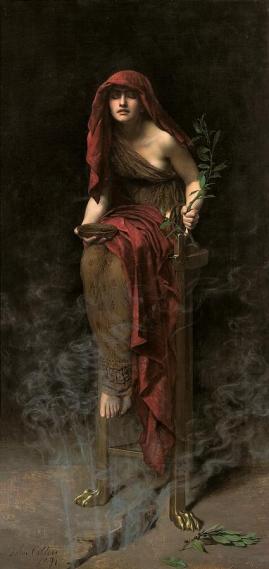
In attempting to rationalize ancient descriptions of the Pythia’s ecstatic trance during which she would give her pronouncements, mainstream modern scholarship has largely

priestess-of-delphi-john-collier
John Collier, Priestess of Delphi (1891)

chalked this state up to “poetic inspiration,” with other scholars attributing it to ethylene fumes that could have wafted up from a fracture in the limestone, created by two hidden, intersecting faults directly under the temple. This idea of drug usage doesn’t suit Delphi’s idealized constructions of modern mainstream scholarship and effectively invalidates a rational understanding of the priestesses because of the general Western belief that drugs are irrational. Even the author of our textbook totally discounts the idea of psychotic usage in his section of Chapter 7 on Delphi, deeming it a “misconception,” that the “priestess was not a wild woman.” (184) It would seem that such assumptions stem from notions of cultural inferiority connected to drug usage. Yet these assumptions only function to limit or even totally prevent us from attaining a fuller understanding of such a society’s social norms and practices.

Following from this recognition of societally-imposed constraints in complete comprehension of the operations at Delphi, I decided to explore alternative theories as to what caused the strange state of the Pythia. I found one school of belief to be particularly convincing: the strange behavior of the Pythia was caused by the consumption of the oleander plant. Ancient sources describe the Pythia chewing “laurel” leaves and inhaling its smoke during the oracular process to inspire her divine mania. Both Lucan and Plutarch confirm this in their preserved writings.

The generic term “laurel” plant described in ancient sources is generally understood to reference the sweet bay plant, yet sweet bay produces none of the symptoms so famously recorded in the sources. However, another similar plant native to the Mediterranean region called oleander does fit this physical and toxicological description. Every single part of the oleander plant is poisonous: a lethal dose is somewhere between 5 and 15 leaves, after their poisonous glycosides have been fully absorbed by the body. Characteristic symptoms of contact include nausea, vomiting and abdominal pain; other symptoms may include hoarseness due to vocal edema, increased salivation, burning of the mouth, paresthesias of the tongue, and death. Neurological symptoms of oleander poisoning manifest themselves as states of increased excitement and agitation; other neurological symptoms include “tremor, drowsiness, ataxia, visual disturbances (yellow vision), mydriasis, weakness, and seizures.” (Harissis, 2014) These symptoms are acutely reminiscent of descriptions of the Pythia during her trance; her state was defined by her possession by Apollo, and was most basically understood to be epilepsy, which was considered during this time period to be the “sacred disease.” This state has also been recounted to include agitation, bounds, and leaps, “harshness” of voice, intense salivation, ataxia, loss of senses, and sometimes death (Lucain, De bello civili; Plutarch, Amatorius, De defectu oraculorum; Scholion, Aristophanem Plutum). Both the symptoms of oleander poisoning and the obfuscation of ancient categorizations of “laurel” create a convincing argument for the oleander theory as the cause of the unusual state of the Pythia at Delphi.


References:

Harissis, Haralampos V. “A Bittersweet Story: The True Nature of the Laurel of the Oracle of Delphi.” Perspectives in Biology and Medicine, vol. 57, no. 3, 2014, pp. 351–360., doi:10.1353/pbm.2014.0032.

Emma Dench at the Athenaeum: “What Can the Romans Do For Us?”

“En Romanos, rerum dominos, gentemque togatum!” – Whoa, the Romans, masters of the world, the toga-wearing people!

[Quote taken from one of her presentation slides]

Last week I attended Dr. Emma Dench’s Athenaeum talk on “What Can The Romans Do For Us?” Dr. Dench used chronologically-organized anecdotes, myths, and artifacts from her studies of ancient Rome to reflect on modern conceptualizations and applications of Roman ideals and practices. She argued for a deeper appreciation for the dynamic and complex model of Rome that would go on to inspire many of our own modern institutions and concepts including empire, migration, human differences, art, and civilization as a whole. Even on the most basic level of our perceptions of Rome, she revealed the paradox of an empire glorified in violence and injustice that clashes terribly with the high esteem we hold for this ancient society and scholarship’s historical lamentation for the fall of the empire. She described this paradox more personally, when she characterized the violent, sexist, racist aspects of Roman culture that she has passionately studied and dedicated her life’s work to. She laughed at this and quipped, “But I love to hate the Romans!”

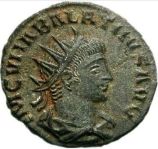
She began by delving into the foundational myths of Rome, which are dominated by the narratives of Aeneas and the legendary brothers and founders of Rome, Romulus and Remus. She highlighted Roman origins as primarily representations of refugees; from the twins being abandoned, washed ashore and cared for by a wolf, to the infamous rape of the neighboring Sabines, to the later political practice of extending Roman citizenship to all conquered peoples and even freed slaves. This hybrid history shows up on monuments like the column of Trajan that depicts a unit of dreadlocked soldiers from North Africa, and even on rogue imperial coins modeled after those of Marcus Aurelius yet with the face of a rebellious Syrian emperor of Palmyra named Vaballathus.

Antoninian_Vaballathus_Augustus_(obverse)
Vaballathus as Emperor on the observe of a Palmyrene Antoninianus, 271 CE

Interestingly enough, she pointed out that the Romans were interested in conquering (generally through violence), and not the exportation of their culture, as modern mindsets tend to assume. Yet the resulting “glue of the Empire,” constitutes a common humanity we share with the Romans. I really enjoyed how she explored Roman legacy as a means of understanding and aspiring to our own personal legacies and that of our greater collective society’s legacy. By recognizing compatibilities, parallels, and differences between societies like Rome and our own, we gain a greater awareness of ourselves.

Emma Dench is author of From Barbarians to New Men: Greek, Roman, and Modern Perceptions of Peoples from the Central Apennines (Clarendon Press, Oxford, 1995) and Romulus’ Asylum: Roman Identities from the Age of Alexander to the Age of Hadrian (Oxford University Press, 2005). Currently, she is working on a study of the retrospective writing of the Roman Republican past in classical antiquity, as well as finishing Imperialism and Culture in the Roman World for the Cambridge University Press series Key Themes in Ancient History.

Consciousness and Curation


In this week’s blog post I am going to explore art history through a philosophical perspective. More specifically, I want to apply concepts from studies of injustice to examine what drives people, in particular curators, to value and study artifacts of the past. Our in-class seminar delved into the acquisitionary practices of museums such as the Getty and how such institutions motivate and create demand from the shadowy underground world of forgeries and the illegal art trade. As a philosophy student, I perceived many of the questions posed as questions more of logical morality with applications in law than anything else: how do we ascribe ownership of artifacts to countries? What about artifacts that were removed generations ago? If they were stolen or looted, does that change anything? How do we go about evaluating authenticity of artifacts? How thoroughly do we evaluate them? Do we place more value on preserving artifacts, their find-spots, or displaying them to a broader audience?

What I found most interesting was the role of curators and their own personal motivations for studying, acquiring, and displaying artifacts. The idea that Western classicists feel something akin to ownership towards the objects they study and acquire is revealing of the societally-constructed role that curators hold in both the art world and the real world.  Personal anecdotes and writings of many curators, both modern and older, use fascinating emotional descriptions of newly-acquired or favorite artifacts. Curating for high-profile and wealthy museums combines power and money, effectively creating the deep connection that borders on ownership that many curators seem to display. However, at the center of the motivational factors lies a passion for the study of art and history, revealed in the pathos of curators describing artifacts they feel connections with. What inspires this more sentimental drive?

I believe it lies within a love of the very cultures of the past that curators and other such professionals dedicate their lives and careers to. Understanding the past through a society’s artifacts is our best and only option in some cases. Because physical objects can be so limiting in what they conclusively tell us, I suspect that curators subconsciously utilize other ways of connecting with both the artifact and its past to deepen their own academic relationship with it. This requires a kind of embodied engagement similar to a concept called third-order change in the field of epistemology, specifically as it is manifested within studies of oppression. Third-order changes are used to address contributory injustices, which are willful ignorance that maintain and utilize structural prejudices and their resulting prejudiced resources. A third-order change, colloquially understood as a practice of “world-traveling,” “requires perceivers to be aware of a range of differing sets of hermeneutical resources in order to be capable of shifting resources appropriately.” (Dotson, 2012) Described as almost a mystical connection with another culture that allows one to simultaneously understand and appreciate genuine cultural differences of others, it is very difficult to do — some argue that it is actually unattainable. The innate, indescribable need of curators and other to connect with ancient cultures on a deeper, “mystic” level that is nearly unattainable in order to totally connect with that society’s social collective resources can be best understood by borrowing these concepts from epistemology. This intersection of epistemology and injustices with modern wrongs (aka a lack of understanding or knowledge) to ancient objects effectively marginalizes original owners of artifacts owing to their static location in history. I think that curators use their own form of third-order changes on a personal level to overcome the static nature of histories and cultures of objects of the past that are essentially a form of contributory injustices.

References:

Dotson, Kristie. “A Cautionary Tale: On Limiting Epistemic Oppression.” Frontiers: A Journal of Women Studies, vol. 33, no. 1, 2012, p. 24., doi:10.5250/fronjwomestud.33.1.0024.