Ancient Arms and Modern Misconceptions

The ascension of Greek societies to a higher existence, namely that of the poleis or “citizen-state,” was most notably marked, for the purposes of this discussion at least, by the rejection of weaponry. This state of civil society no longer held weapons as morally-sound images of power; instead they condemned them as ugly markers of an uncivilized past where brute strength ruled and dominated. How can respectful discourse be exchanged equally on behalf of both parties if the armed are arguing with the unarmed? Ancient Greek historian Thucydides, in his “History of the Peloponnesian War,” attributed the complete development of Athenian civilization to the end of quotidien weapon-carrying. He underscored the correlation between Athens’ elevated status as a center of trade and culture in the ancient world and the fact that it was the first poleis to give up their daily weaponry habits. Ancient Rome too, recognized the dangers to civic equality that weaponry in public spaces posed, and banned weapons inside the pomerium, or sacred city limits. Armies were forbidden from entering the city save for very special triumphal celebrations, housed instead in barracks outside the city walls. Upon entering, soldiers were generally supposed to be in civilization dress and were considered under the law as citizens, not soldiers. Even on the fateful Ides of March of Caesar’s assassination, did his killers carefully plan his death to happen outside the pomerium, at the Theater of Pompey instead of the usual Curia Hostilia.

James Whitley’s Part II of The Archaeology of Ancient Greece, portrays ‘civil society’ in their rejection of weaponry as images of power, arguing that displays of weaponry are indicative of small kingships rather than large-scale civil society. What does this say about American society today? A paraphrase associated with Benjamin Franklin’s reflections on Greek law and order from the early 19th century holds, “Let the laws rule alone. When weapons rule, they kill the law.” It seem that the idea of our Founding Fathers to protect a citizen’s right to maintain a militia and bear arms (if their aim was truly to mirror ancient Hellenistic democratic ideals as modern perceptions hold it to be), has been effectively misrepresented in today’s day and age to serve more nefarious purposes. This right was far more applicable in Ancient Greece when the citizen elite who could afford to arm themselves fought for glory in protecting their poleis; or later on during the pioneer days of early colonization, when guns and militias were sometimes the only form of necessary protection available. Benjamin Franklin and Julius Caesar would likely be horrified to see the manner in which basic functions of civil society have been perverted to enable weaponry usually reserved for extreme military warfare handed out within city boundaries to anyone who wants a weapon to wave around.


Sphinxes: A Study of Symbology

390px-Fernand_Khnopff_002

The sphinx as we know it today is a mythical creature with the body of a lion and a human head. Immortalized forever in the dramatic mythological tale of Oedipus, a malevolent sphinx guarded the entrance to the city of Thebes, posing a riddle to anyone who dared to enter, and killing them where they stood when they were unable to answer her riddle. The hero Oedipus was finally able to solve her riddle: “Which creature has one voice and yet becomes four-footed and two-footed and three-footed?” by answering, “Man—who crawls on all fours as a baby, then walks on two feet as an adult, and then uses a walking stick in old age.”

220px-Great_Sphinx_of_Giza_-_20080716a
The Great Sphinx of Giza, Egpyt, ~2500 BCE

Yet the globalized iconographic symbol of the sphinx extends far beyond this Hellenistic legend and through far more millennia. I was surprised and impressed to learn that sphinx-like representations can be found across the world in vastly different and temporarily-removed ancient civilizations. On page 102 of Chapter 4, Neer explores the adaptation of Eastern sphinxes by the Greeks from earlier Syrian and Levantine models as they began to reappear in post-Bronze Age art at the start of the 7th century. He uses them as an example of how myth could be invented to explain strange or confusing images from such Eastern imports, and not the other way around as we usually understand passive imagery to be realized in the art historical and archaeological records.


I want to explore the globalized nature of the sphinx icon as an example of iconographic parallels across seemingly unconnected and geographically-removed ancient societies. Beginning with the largest and most famous sphinx; the Great Sphinx of Giza,

240px-Loewenmensch2
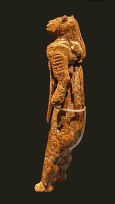
Löwenmensch figurine or Lion-man of the Hohlenstein-Stadel, dated to the Upper Paleolithic (about 35,000 to 40,000 years ago)

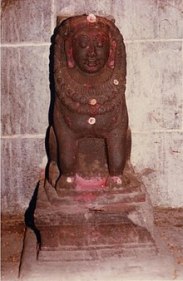
controversially dated to around 2500 BCE during the reign of the Pharaoh Khafre of the Old Kingdom period. It constitutes the oldest known monumental sculpture in Egypt and is a monumental manifestation of massive proportions, measuring 73 meters (240 ft) long from paw to tail, 20.21 m (66.31 ft) high from the base to the top of the head and 19 meters (62 ft) wide at its rear haunches. The oldest known sphinx however, was found near the Gobekli Tepe site in Turkey, just north of the Syrian border. It is dated to around 9500 BCE, predating the Egyptian and Greek finds by thousands of years. However, the oldest zoomorphic sculpture ever discovered, credited to be the oldest uncontested figurative art find in history also evokes sphinx-like motifs; carved out of mammoth ivory with the use of a flint stone knife. This lion-headed figurine was found in a stratigraphic layer of a cave in Germany that was carbon-dated to be between 35,000-40,000 years old, and dubbed the Löwenmensch figurine or Lion-man of the Hohlenstein-Stadel.  In Southeast Asian art and mythology, this icon takes various diverse forms: manusiha or manuthiha (Pali, “man-lion”) in Myanmar, or as nara-simha (Sanskrit, “man-lion”) in Sri Lanka, purushamriga (Sanskrit, “man-beast”), purushamirugam (Tamil, “man-beast”), naravirala (Sanskrit, “man-cat”) in India, and norasingh (from Pali, “man-lion”, a variation of the Sanskrit “nara-simha”) or thep norasingh (“man-lion deity”), or nora nair in Thailand. Ancient Iranian societies had the Gopaitioshah, or Gopat, a winged lion with a human face, dated to around 2000 BCE and an important symbol of royal power.


220px-Purushamrigachidambaram01
Male purushamriga, Shri Shiva Nataraja temple, India, 5th century CE.


Across societies, young and old, these icons of royal power served similar purposes of guarding liminal areas such as temples, cities and sanctuaries. The fusion of powerful animalistic feline and human knowledge fused to create a formidable, super-human divine guard. Benevolent or malevolent, sphinxes and sphinx-like symbols are a timeless and globalized motif that can be traced to the very beginnings of humanity and human artistic representations.


Interstate Ideologies

In our reading of Neer’s Chapter 3 this week, my interest was piqued by a small subsection on page 85 on interstate shrines. Since there was only a little bit of information on interstate shrines and their functions, for my blog post this week I wanted to explore the topic more in-depth.

Neer describes interstate shrines as those “independent of their home cities,” with a two-fold function of “provid[ing] venues for conspicuous consumption by aristocrats,” and “housing oracles as at Delphi.” (85) He paints a romanticized portrait of these geographically isolated shrines as elitist and athletic. Neer notes that the material record displays large amounts of private dedications, with little attention paid to architecture or architectural forms.

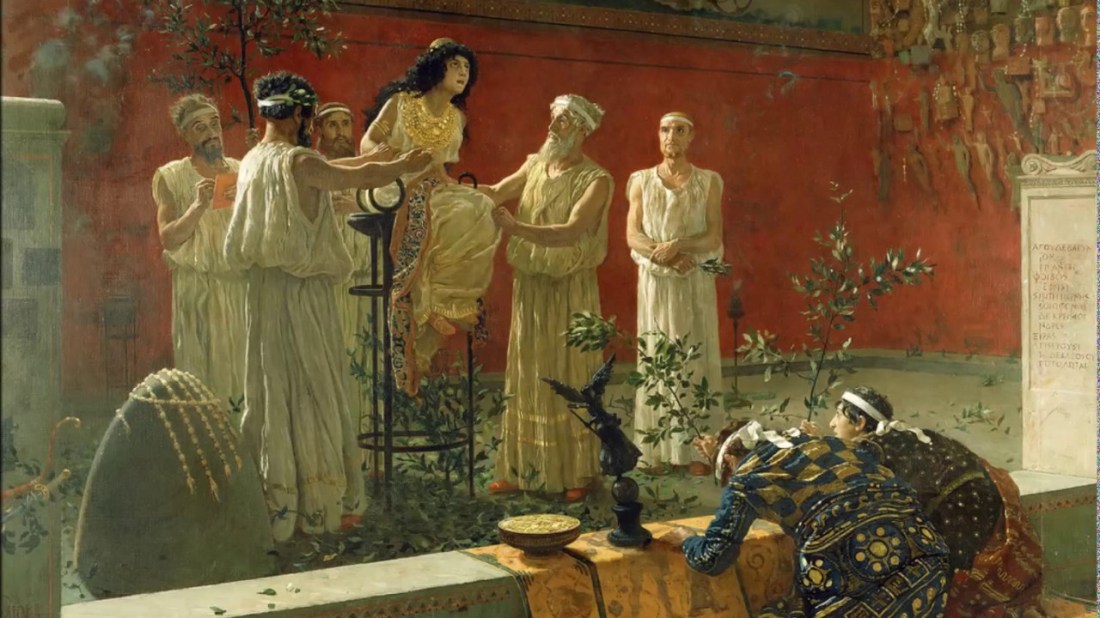
The most interesting concept I encountered in relation to these ancient shrines was their implicit function as neutral ground, providing arbitration areas and even mechanisms for public and private disputes. Oracles even served to legitimize courses of action when no consensus could be agreed upon: a yes-or-no question would be appealed to a god, and their response would form the concurrent course of action.

DELPHI.jpg

(An artist’s rendering of a priestess at Delphi. Note the luxurious displays in the image)

The Cambridge Companion to Archaic Greece offers some interesting insight into the defining contributions of interstate shrines towards elitism and elite ideologies in the ancient world. These sanctuaries were so appealing to the wealthy of old because of “the fact that they were not under control of any single city.” Instead, they were positioned exactly “in the interstices of the polis world.” (229) They provided an important platform for social displays of both physical and economic strength, and asserted bonds of camaraderie and solidarity among participants. These assertions in turn made the implied claim among the larger Greek communities that “wealth, or birth, or a special relationship with the gods was of greater significance than membership in a particular citizen community.” (229) I don’t think such displays of overt economic fortitude or physical demonstrations in games for rich young boys to play would have gone over so well in more normalized polis settings. I find the paradoxical social nature of these interstate shrines very interesting, and am considering doing my extended essay on the topic. I wonder if parallels could be drawn to certain hotels or restaurants in the modern world? While at first these shrines appear to be simply ritualistic, or escapes from everyday religious functions of the polis, their deeper and perhaps more dark civic capacities can be understood through more in-depth analysis and discussion much like this one.

Pros of Priam’s Treasure

“In excavating this wall further and directly by the side of the palace of King Priam, I came upon a large copper article of the most remarkable form, which attracted my attention all the more as I thought I saw gold behind it. … In order to withdraw the treasure from the greed of my workmen, and to save it for archaeology, … I immediately had “paidos” (lunch break) called. … While the men were eating and resting, I cut out the Treasure with a large knife…. It would, however, have been impossible for me to have removed the Treasure without the help of my dear wife, who stood by me ready to pack the things which I cut out in her shawl and to carry them away.”

-Heinrich Schliemann on the discovery of “Priam’s Treasure,” May 27th, 1873

Sophia_schliemann_treasure
Sophia Schliemann

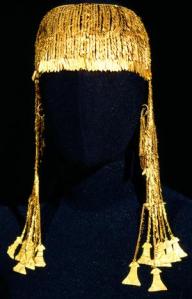
In this week’s blog post, I want to explore the more admittedly-spurious idea of the value of portraying artifacts like the jewelry from the so-called “Priam’s Treasure” worn by Sophia Schliemann in her infamous Helen of Troy photograph as the priceless and spectacular commodities they truly are. Let me be clear: I am not arguing in favor of the “spectacularization” process of archaeological finds exemplified in this anecdote, nor am I condoning Schliemann’s capitalistic enterprises whatsoever, I am simply wondering if there may be some positive aspects of this approach that we have overlooked in our haste to reject it in following the proper social norms of historians and archaeologists alike.

I will not deny my initial reactions of horror and shock to learn about Schliemann’s archaeological practices and to see the photo of his wife, Sophia, wearing the jewelry herself. Not only was this grave robbery, it was destruction of an archaeological site of tremendous value and theft of the objects by Schliemann from it’s rightful country. Yet I found myself marveling at the beauty of the artifacts themselves situated and worn exactly as they would have been thousands of years ago. The craftsmanship of the gold jewelry is entrancing and awe-inspiring, and this impression is only furthered by being modeled/displayed exactly as the original artist would have intended it to be. Would the ancient artist have wanted their work displayed in such a spectacular fashion, circulated globally and immortalized in the photograph of Sophia Schliemann? Kathrin Maurer’s work, “Archaeology as Spectacle: Heinrich Schliemann’s Media of Excavation” presents an interesting notion that Schliemann’s staging of his archaeological findings through photography “advertise their actuality and eternal presence.” In this sense, the spectacularization of the jewelry honors the extraordinary work of the artist as well as her/his society through its timelessness. The artifacts presented in such a way are able to engage a much larger audience, thus encouraging a more wide-spread and deeper respect for an ancient society. What artisan wouldn’t want their work to be so valued and revered by so many for millennia? The fact that the treasures are actually dated to around 1000 years before Homer’s legendary King Priam lived only adds to this notion of eternality.

Diadem from "Priam's Treasure"We are quick to criticize modern promotions (in the spectacularization and capitalistic fashions), perceptions and interpretations of history along with their connected archaeological finds, yet it is important to recognize positive aspects as we attempt to reconcile such social processes. Through the spectacular presentation of “Priam’s Treasure,” epitomized by the photograph of Sophia Schliemann, we are shown a natural presentation of artifacts whose aesthetic value transcends the traditional temporal boundaries of history and promotes eternal honor for the ancient society and the craftsmanship of the artist.

Palatial Problems

As society progressed during the Early Bronze Age, large administrative and religious centers began to appear across the ancient Greek world. I was confused in my readings this week of Chapters 1 and 2 of Greek Art and Archaeology by Richard Neer to learn that modern scholarship has labeled these architectural forms as “palaces,” blatantly disregarding their true function and the history of the word itself. In this blog post, I will explore my questionings of the usage of this term by academics, the true origin of the word, and why it should not be used.

These buildings, or collections of buildings provide no evidence leading to residential purposes; on the contrary they were collection and distribution centers for local produce and trade. While the “palaces” were central to regional societies, their functions as deeply economic in nature with some political and religious ones, do not fit with the usage of the word “palace” to describe them.

In my Roman Art and Archaeology class last year, I learned that the word “palace” actually comes from the Latin word palatium, meaning “the Palatine hill,” or in plural, “a palace.” The Mons Palatinus or “the Palatine Hill,” was one of the seven hills of ancient Rome, where Augustus Caesar’s house stood (the original “palace”), later the site of the massive Domus Aurea built Nero. The English, the general sense of “splendid dwelling place” is dated the late 14th century. While this is all background knowledge that many people may not have, it is important that when thinking about the history of places or societies, we, as historians represent ideas as accurately as we can, instead of projecting our own perceptions of the ancient world.

Naming such architectural forms as palaces is not only misleading to the academic and archaeological worlds; as well as the general public, but misrepresentative of the functions and history of the palaces and their associated art forms. Descriptions of art styles, such as the “Special Palace Tradition,” and time periods such as “Second Palace Period,” or “Post Palatial Period,” mistakenly buy into this verbiage, effectively distort the history of centuries of Hellenistic and Minoan culture and society. Ironically, we can find parallels to this type of literary error in the term “Minoan,” as well. Using the Minotaur myth that originated in Crete to describe the time period subconsciously promotes a false narrative of the region. While it may not always be possible to label such concepts correctly given the fractured nature of the archaeological record in many cases, it becomes so much more important for things we do know about, such as the Bronze Age “palaces,” to be presented truthfully.


Introduction

My name is Bryn Edwards, I am a dual Government and Philosophy major at Claremont-McKenna College hailing from Arlington, VA. This is my third year of studies here at the Claremont Colleges, and in my free time I can usually be found at swim practice with the CMS team. After a riveting Roman Art and Archaeology course last year, I decided to complete Scripps College’s Art History minor requirements as well. My interest in art history lies primarily in the classics; so Roman and Greek art are two great foundational classes for me to begin with. Last spring I also took a class on ancient disasters of the Mediterranean with the same professor, allowing me to gain more background knowledge of the societal and historical lore of the region. What struck me most about my experience studying ancient Roman art the political role art played in the time period – by the end of the course I was thoroughly convinced that Augustus’ wildly innovative and successful propaganda campaign through art and architecture solidified his claim to power and essentially build the empire after the chaos following the death of Caesar. Never before had I realized the monumental power that art held over ancient societies as a major proponent of both culture and information. This summer I wandered the streets of Rome with an entirely new way of regarding the eternal city, focusing on the columns and arches instead of the gelato and pizza. Since much of the Roman art world can trace it’s roots to Greek origins and masterworks, I thought it would be intriguing to work backwards through the art and the history from Rome to Greece in order to gain a more holistic view of ancient Mediterranean art. As a government major, I am most interested to learn about the role art played in politics; how it can make or break a leader or their legacy, and even their power over the people. I want to add to my knowledge of classical art, focusing on the Greek masterworks and techniques that inspired the Romans and continue to inspire us today.